Live demo · sluice-demo.mikodes.com

Run the rounds. Take a fee on each.

Projects fund a pool; SLUICE measures who holds the token, divides the pool and prepares the transactions for the project to sign. You run it for several projects and take a fee on every round — shown to them before anything moves.

The real web build with a labelled sample project (passcode sluice-demo). It reads no chain, holds no key and moves nothing.

  • Solana token distribution
  • Flutter source code
  • 16 docs pages
sluice-demo.mikodes.com
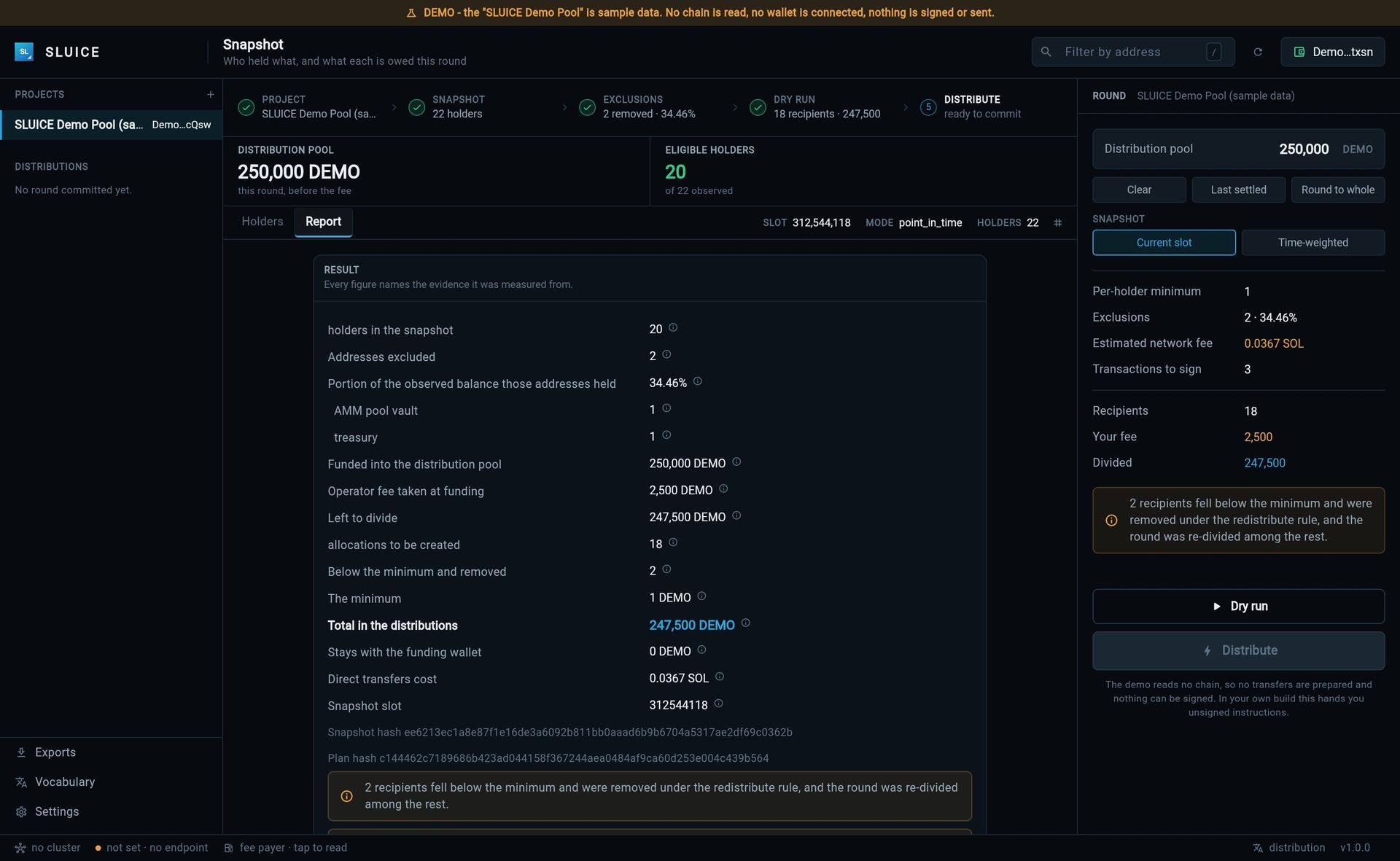
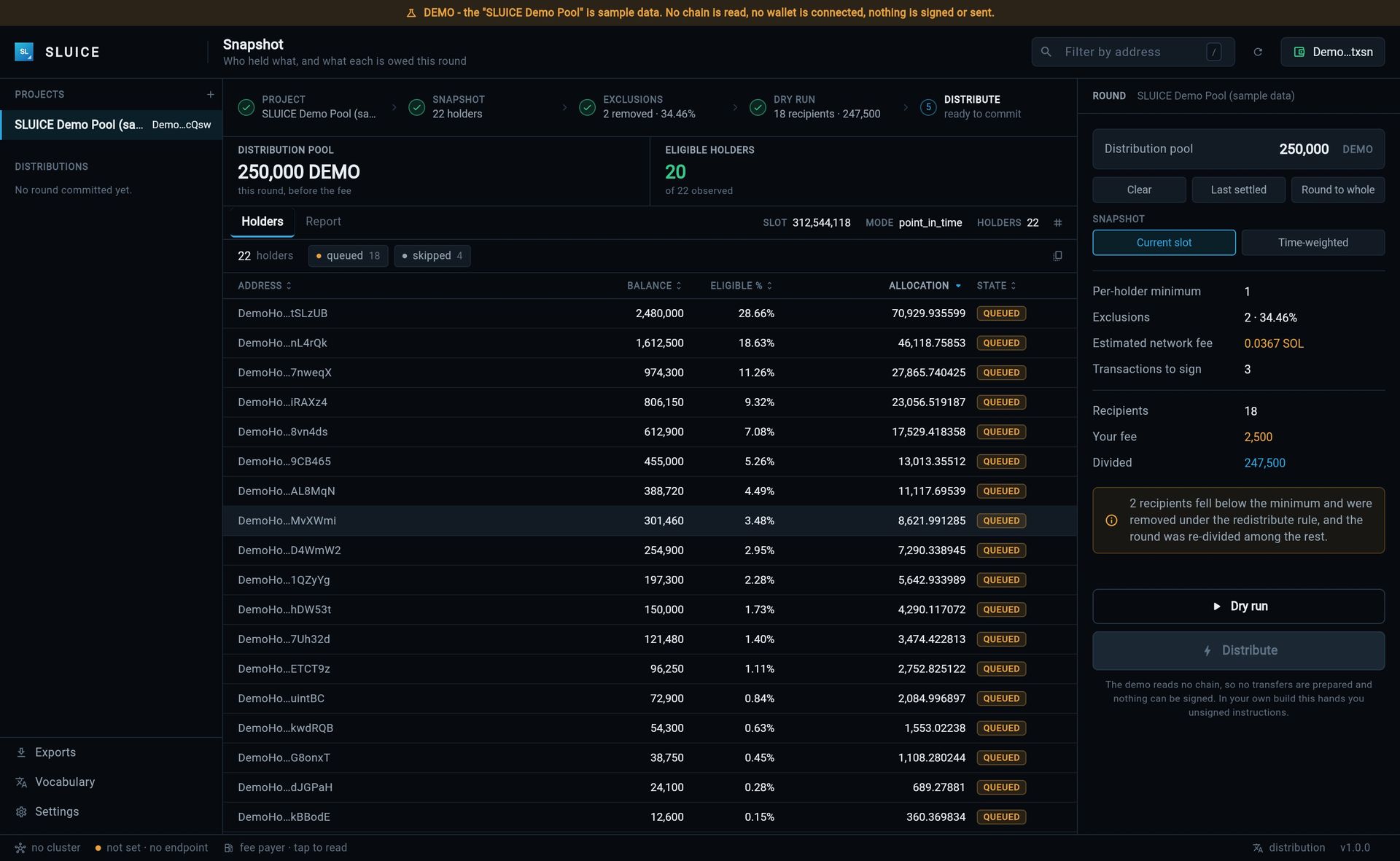
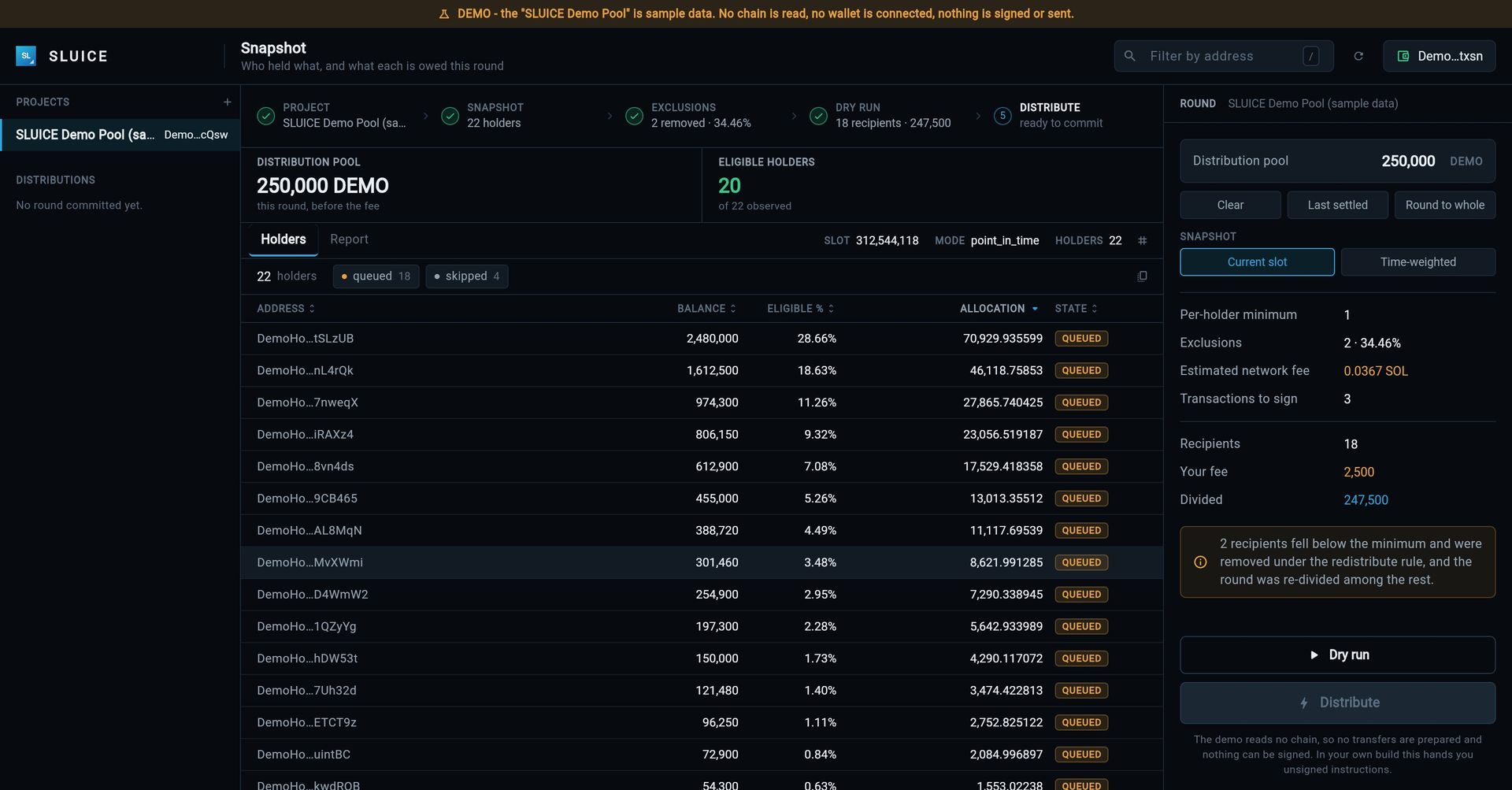
SLUICE demo build on the sample project: the five-step strip, the distribution pool, the eligible holders and the round panel with Dry run and Distribute
fee cap per round, in code2%
9:41
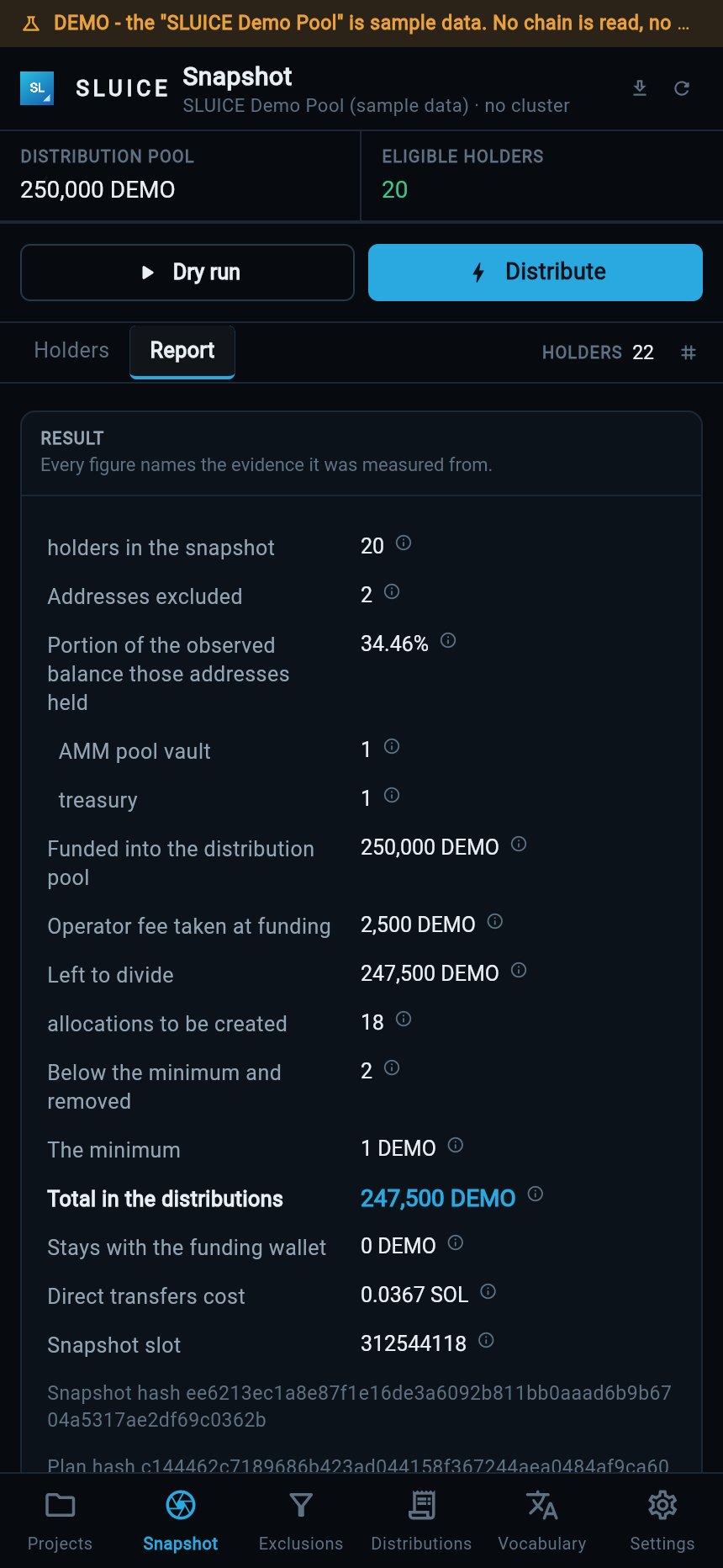
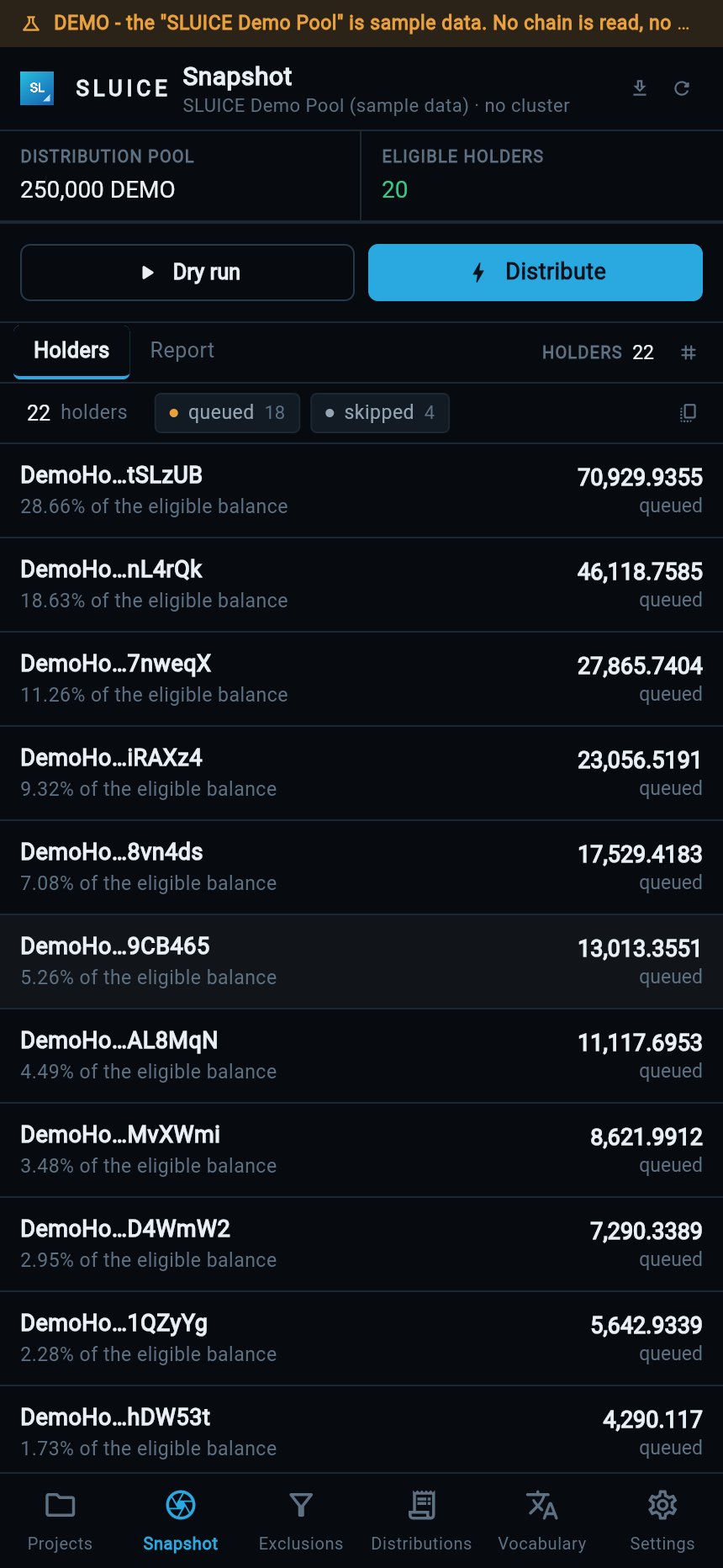
SLUICE on a phone: the snapshot of the sample project, holders and what each is allocated
sluice-demo.mikodes.com · sample data
SLUICE snapshot view on the labelled sample project: projects rail, the five-step progress strip, distribution pool and eligible-holder counts, and the round panel.
The labelled sample project of the public demo. It reads no chain and signs nothing.

Built on

  • Solana
  • SPL tokens
  • Web
  • Solana
  • SPL tokens
  • Web
  • Solana
  • SPL tokens
  • Web
  • Solana
  • SPL tokens
  • Web
  1. Snapshotholders at the current slot, or time-weighted over a window
  2. Excludepool vaults detected, plus treasury, team and your list
  3. Dry runwho gets what, what it costs, your fee — nothing moves
  4. Distributeunsigned batches; the project signs, each batch is checked on chain

Business plan

A token distribution service.
A fee on every round.

Buy the source code once. Run it under your brand. The revenue lines are already in the code — they pay you, not us.

  1. 01Buy the sourceSnapshot, exclusions, dry run, distribution.
  2. 02Brand itYour fee wallet, a rate, a flat amount per round — or both.
  3. 03LaunchRun it for projects; they sign, you never hold keys.
  4. 04GrowEvery project you onboard runs round after round.

Who runs it

  • Launch agencies and KOL managers
  • Community managers running airdrops
  • Token projects distributing to holders

Where the money comes from

    Running costs Static hosting and a Solana RPC.

    How the buyer earns

    You earn on
    every round you run.

    • Set a fee wallet and a rate, a flat amount per round, or both. One setting applies to every project you run.
    • The fee is taken from the funded amount before it is divided, shown on the dry run and paid as its own batch the project signs.
    • Capped in code at 2% of the round — rate and flat amount together — so a hand-edited settings file cannot get round it.
    • Ships empty: no fee wallet and a zero rate. A fee that would pay nothing says so on the dry run instead of failing quietly.
    2%fee cap per round, in code
    0keys held by SLUICE

    What it does

    Every holder measured.
    Every figure reproducible.

    current-slot snapshothash
    time-weighted balancesamples
    Token-2022same snapshot → same plan

    Snapshots that resist gaming

    Read balances at the current slot, or time-weighted over a window from recorded balance samples, so a wallet cannot buy a minute before the snapshot and take a full share.

    Every round reproducible from its snapshot hash
    Pool vaultoff-curveexcluded
    Treasuryyour listexcluded
    Holdera walletincluded

    Exclusions nobody types

    AMM pool vaults are detected: an authority off the ed25519 curve has no private key, so it is a program, not a person. Add exchanges, burn, treasury and team wallets.

    The dry run shows what each exclusion removed
    MethodPro-rata by balance
    Remainderlargest fraction first
    tiersdust re-dividedinteger units

    Pro-rata or by tier

    Pro-rata, or by tier with the tier editor. Computed in integer base units with a documented rounding rule and dust rule. A minimum per holder keeps out recipients who would cost more in fees than they receive.

    Holders never see a projected rate
    Dividedto holdersunits
    Networkper batchSOL
    Your feeown lineshown

    Dry run before money

    Who gets what, what the transfers cost in SOL, what the exclusions removed — and your fee as its own line. It costs nothing and moves nothing.

    Every batch carries Compute Budget instructions
    direct transfers, unsignedyou sign
    recipients + amounts on chainfinalized

    Direct transfers, checked

    SLUICE prepares unsigned transfer batches for the project's own wallet. A batch counts as paid only when the chain shows the exact recipients and amounts.

    A resumed round never pays a batch twice
    rewardsdistributionrevenue sharedividendyieldcustom
    Preset changed0 figures changed

    Your words, same numbers

    A vocabulary preset — rewards, distribution, revenue share, dividend, yield or your own — changes the words across the console and the exports.

    A test holds it: switching a preset changes no figure

    Illustrations of built features. The demo runs the real build on a labelled sample project.

    The rest of the product

    What you cannot see from the front.
    Setup, what is excluded, and the report that proves it.

    A distribution is only as good as its arithmetic. These are the screens that show the arithmetic — and the one that says what the operator still has to supply.

    What does setting it up involve?

    sluice-demo.mikodes.com · sample data
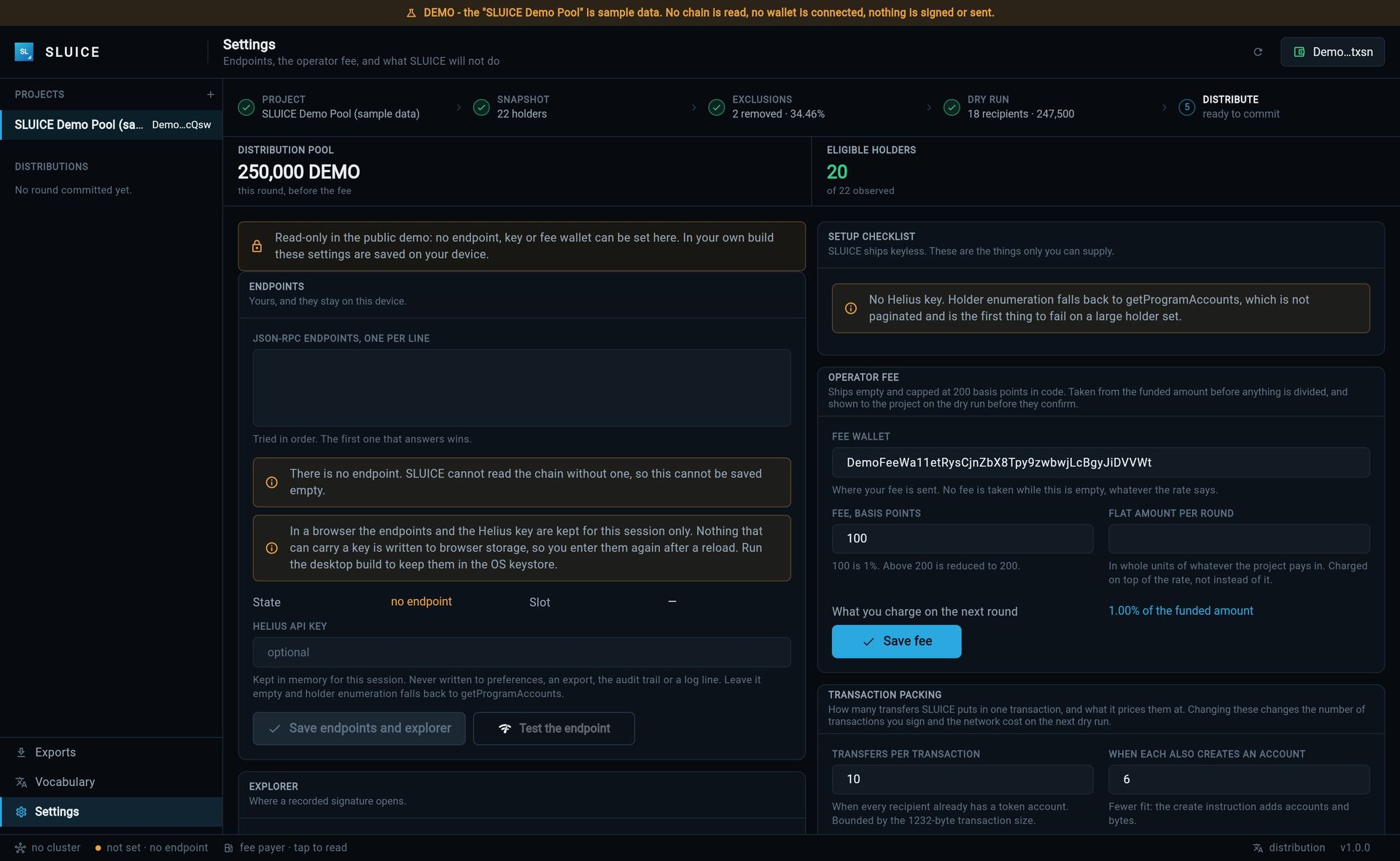
    SLUICE settings in the demo: a setup checklist saying there is no Helius key and holder enumeration falls back to getProgramAccounts, the JSON-RPC endpoint list, the operator fee with a sample fee wallet and 100 basis points, and transaction packing.
    SLUICE ships with no credential of its own and says so on this page. The checklist names the two things only the operator can supply, and the effective configuration shows what is actually in force rather than what was intended.

    What happens when something goes wrong?

    sluice-demo.mikodes.com · sample data
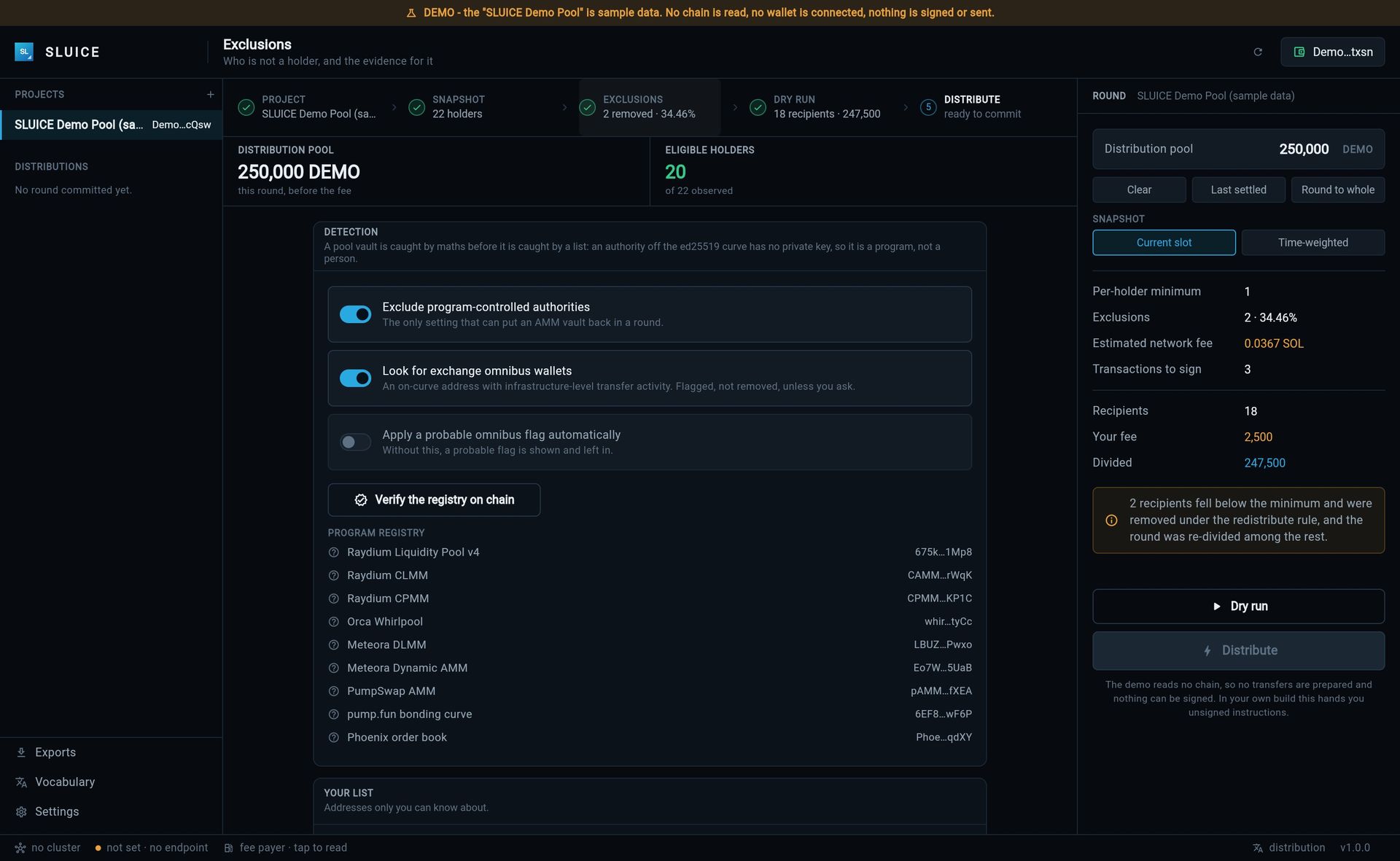
    SLUICE exclusions on the sample project: detected pool vaults and the operator's own list, each removal shown with where the address came from.
    What gets taken out of a distribution before it is divided, and where each address came from.

    What does the operator side look like?

    sluice-demo.mikodes.com · sample data
    SLUICE report on the sample round: holders in the snapshot, addresses excluded and the share they held, funded amount, operator fee, left to divide, allocations, below the minimum, direct transfers cost, snapshot slot, snapshot hash and plan hash.
    The round, line by line, with a hash for the snapshot and a hash for the plan so the arithmetic can be checked afterwards.

    What does it look like on a phone?

    9:41
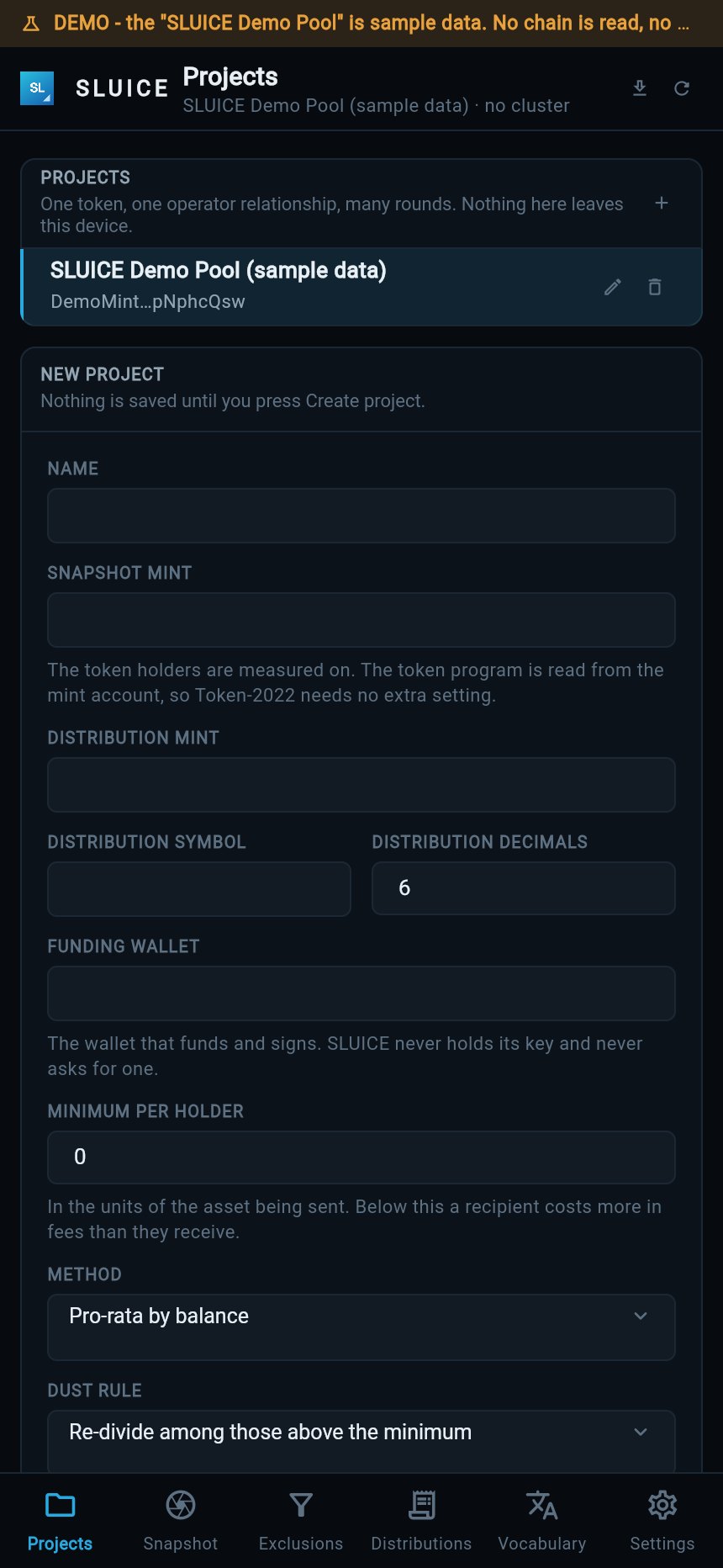
    SLUICE projects on a phone
    Projects
    9:41
    A snapshot on a phone: holders, balances and what each is allocated
    Snapshot
    9:41
    The round report on a phone
    Report
    The same console on a phone: projects, the snapshot and the round report.

    Interactive tour

    See every screen.
    Then try it live.

    Real screens from the product. Click a screen to enlarge it.

    sluice-demo.mikodes.com
    SLUICE demo build on the sample project: the five-step strip, the distribution pool, the eligible holders and the round panel with Dry run and Distribute
    9:41
    SLUICE on a phone: the snapshot of the sample project, holders and what each is allocated
    sluice-demo.mikodes.com
    SLUICE settings in the demo: endpoints, the Helius key field, the setup checklist, the operator fee at 100 basis points with a sample fee wallet, and transaction packing
    9:41
    SLUICE settings in the demo: endpoints, the Helius key field, the setup checklist, the operator fee at 100 basis points with a sample fee wallet, and transaction packing
    sluice-demo.mikodes.com
    SLUICE exclusions on the sample project: detected pool vaults and the operator's own list, each removal shown with where the address came from.
    sluice-demo.mikodes.com
    SLUICE report on the sample round: holders in the snapshot, addresses excluded and the share they held, funded amount, operator fee, left to divide, allocations, below the minimum, direct transfers cost, snapshot slot, snapshot hash and plan hash.
    9:41
    The round report on a phone

    One settings screen.
    Everything only you can supply.

    Endpoints, the Helius key, the operator fee, transaction packing and a setup checklist that names what is still missing.

    sluice-demo.mikodes.com
    SLUICE settings in the demo: endpoints, the Helius key field, the setup checklist, the operator fee at 100 basis points with a sample fee wallet, and transaction packing
    9:41
    SLUICE settings in the demo: endpoints, the Helius key field, the setup checklist, the operator fee at 100 basis points with a sample fee wallet, and transaction packing
    Open the live demo →

    It prepares.
    The project signs.

    No keySLUICE holds no key and produces no signature. It has no server, so there is nothing to relay with.
    Past onlyEvery displayed number carries its evidence. No projected rate, no expected-amount preview.
    Bring your RPCIt ships keyless on the public endpoint, which rate-limits holder enumeration. Add your own endpoint and Helius key.

    Flutter for macOS, iOS, Android and web. Payouts are direct SPL transfers from the project's funding wallet: no claim page and no on-chain program.

    Documentation

    Installed in an afternoon.
    Every step written down.

    16 pages written from the real code — requirements, install, configuration, deployment, troubleshooting.

    Documentation

    Buy source code

    Own SLUICE.
    Ship it as yours.

    • Full source code, yours to rebrand and run
    • Documentation — 16 pages, also online
    • A live demo to click through before you pay
    • Item support through CodeCanyon

    Installation & customization

    Want it installed on your servers, rebranded or extended? The team that built it does that — write to us.

    SLUICE · source code

    Coming to CodeCanyon

    The source code will be sold on CodeCanyon (Envato Market).

    Click through it yourself.

    Version 1.0.0 · the engine and the operator console · analyzer clean, test suite passing · coming to CodeCanyon

    Installation & custom work

    The download is not the end of it.
    Tell us what you need.

    The code is sold on CodeCanyon. The work around it — getting it live, changing it, or building you something of your own — is ours, and it starts as a conversation on Telegram, not a form.

    Install it for me

    You bought the code and you want it running, not a folder of files.

    • On your own servers, your domain, your keys
    • Your name and colours, not ours
    • Handed over working, with what we changed written down

    Add features

    SLUICE plus the one thing it does not do yet.

    • A screen, a chain, a payment method, a report
    • Built into your copy, so updates still apply
    • We say up front if it is a bad idea

    Build something custom

    A product of your own, on foundations that already work.

    • Starts from what is proven here, not a blank page
    • Yours alone — we do not resell it
    • Same standard as the products on this page

    MIKODES is a Slovak company and has been selling on CodeCanyon since April 2019. 19 products run in the open at mikodes.com — Solana, Hyperliquid, Base, Telegram and WordPress. Tell us what you need and we will tell you what it takes; we will also say when we are the wrong people for it.

    Talk to us

    Start the conversation.

    Telegram is fastest and it reaches the person who built this, in English. Describe what you need and you get an honest answer about what it takes. The source code itself is sold on CodeCanyon.

    Telegram · fastest

    Talk on Telegram

    E-mail

    For installation and customization quotes.

    Other MIKODES products

    Also by MIKODES.

    Live demoBuy source code